

Building Autonomous RAG Pipelines: How We Used LangChain and OpenAI to Extract Insights from Unstructured Customer Docs
Learn how to transform messy customer data into actionable intelligence using advanced AI orchestration.
The Challenge of Unstructured Data
In the modern B2B landscape, your most valuable insights are often trapped in PDFs, email threads, and Slack conversations. We recently worked with a client struggling to reconcile thousands of unstructured customer documents with their CRM data. They needed a way to query this information in real-time without manual data entry. This is where enterprise RAG pipeline development with LangChain and OpenAI becomes a game-changer.
Why RAG is the Standard for Enterprise AI
Retrieval-Augmented Generation (RAG) allows your LLM to "read" your private data before answering a query. Unlike fine-tuning, which is static and expensive, RAG is dynamic. By using LangChain to orchestrate the retrieval process, we can ensure that the AI only references verified, up-to-date documentation stored in your internal systems.
The Architecture of an Autonomous Pipeline
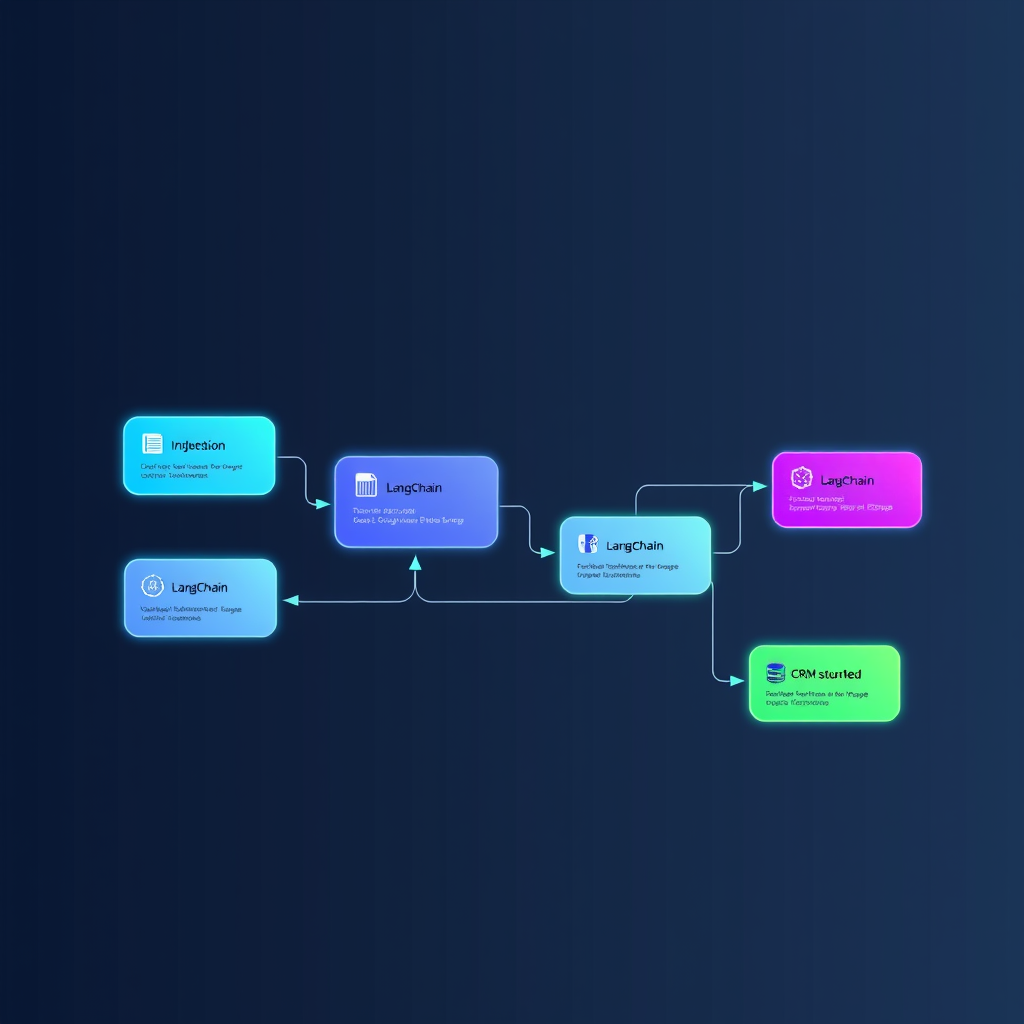
To build a robust system, we rely on a modular stack:
- Ingestion: We use n8n to watch for new documents in Google Drive or email attachments.
- Processing: LangChain handles the document splitting and embedding generation.
- Storage: We push these vectors to a database like Pinecone or Supabase.
- Retrieval: When a user asks a question, the system fetches the relevant context and sends it to OpenAI's GPT-4o.
Step-by-Step: Implementing Your RAG Pipeline
1. Automating Data Ingestion with n8n
Don't manually upload files. We build n8n workflows that trigger whenever a file hits a specific folder. This ensures your knowledge base is always current. By leveraging REST APIs, we can pull data directly from HubSpot or Airtable to enrich the context before it even hits the vector store.
2. Orchestrating with LangChain
LangChain is the glue. We use it to define the "Chain" of thought. First, we define a retriever that searches our vector store. Then, we pass that context into a prompt template. This prevents hallucinations by forcing the model to cite its sources.
3. Closing the Loop with HubSpot
Once the AI extracts the insight—for example, a specific customer pain point or a contract renewal date—we don't just print it to a log. We use an API call to update the corresponding record in HubSpot. This turns a "chat" into a "business process."
Case Study: Reducing Research Time by 80%
We recently deployed this architecture for a logistics firm. They were spending 15 hours a week manually summarizing customer feedback from PDFs. By building an autonomous RAG pipeline, we reduced this to zero. The system now automatically tags HubSpot deals with sentiment analysis and key requirements extracted from those documents.
If you want to see how these Automation Services & Capabilities can be applied to your specific tech stack, we are ready to help you architect your own solution.
Why Enterprise RAG Pipeline Development with LangChain and OpenAI Matters
Many companies try to solve this with simple "chat with PDF" tools. Those are toys. Enterprise-grade automation requires error handling, logging, and secure API management. When you build with LangChain, you get the flexibility to swap models, adjust chunking strategies, and implement guardrails that keep your data secure.
Key Considerations for Success
- Chunking Strategy: Don't just split by character count. Use semantic chunking to keep related ideas together.
- Metadata Filtering: Always attach metadata (like Customer ID or Date) to your vectors. This allows you to filter searches so the AI only looks at data relevant to the specific customer in question.
- Feedback Loops: Use Slack to notify your team when the AI identifies a high-priority insight that requires human intervention.
Ready to Automate Your Knowledge Base?
Building an autonomous RAG pipeline isn't just about writing code; it's about integrating AI into the heartbeat of your operations. Whether you are using Airtable for project management or HubSpot for sales, the goal is to remove the friction between data and decision-making.
If you are ready to move beyond manual data processing, Book a Free Automation Audit with our team. We will review your current workflows and show you exactly where an AI-driven RAG pipeline can save you time and increase your team's output.