

Reducing Customer Churn with Predictive AI: Building a Slack Alert System Using OpenAI and HubSpot
Stop losing revenue by building an automated early-warning system for at-risk B2B accounts.
The Silent Revenue Killer: Why Predictive Churn Analysis Matters
In the B2B SaaS world, churn is the silent killer. By the time a customer submits a cancellation request, it is usually too late. As automation engineers at Deepak Automation, we have seen countless companies rely on reactive dashboards that show what happened last month, rather than what is happening right now. To stay ahead, you need predictive customer churn analysis using OpenAI and n8n for B2B.
By leveraging LLMs to analyze qualitative data—like support tickets, email sentiment, and usage patterns—you can move from reactive reporting to proactive intervention. In this guide, we will break down how to build a production-grade pipeline that alerts your Customer Success team via Slack before a client even considers leaving.
The Architecture: Connecting Your Data Stack
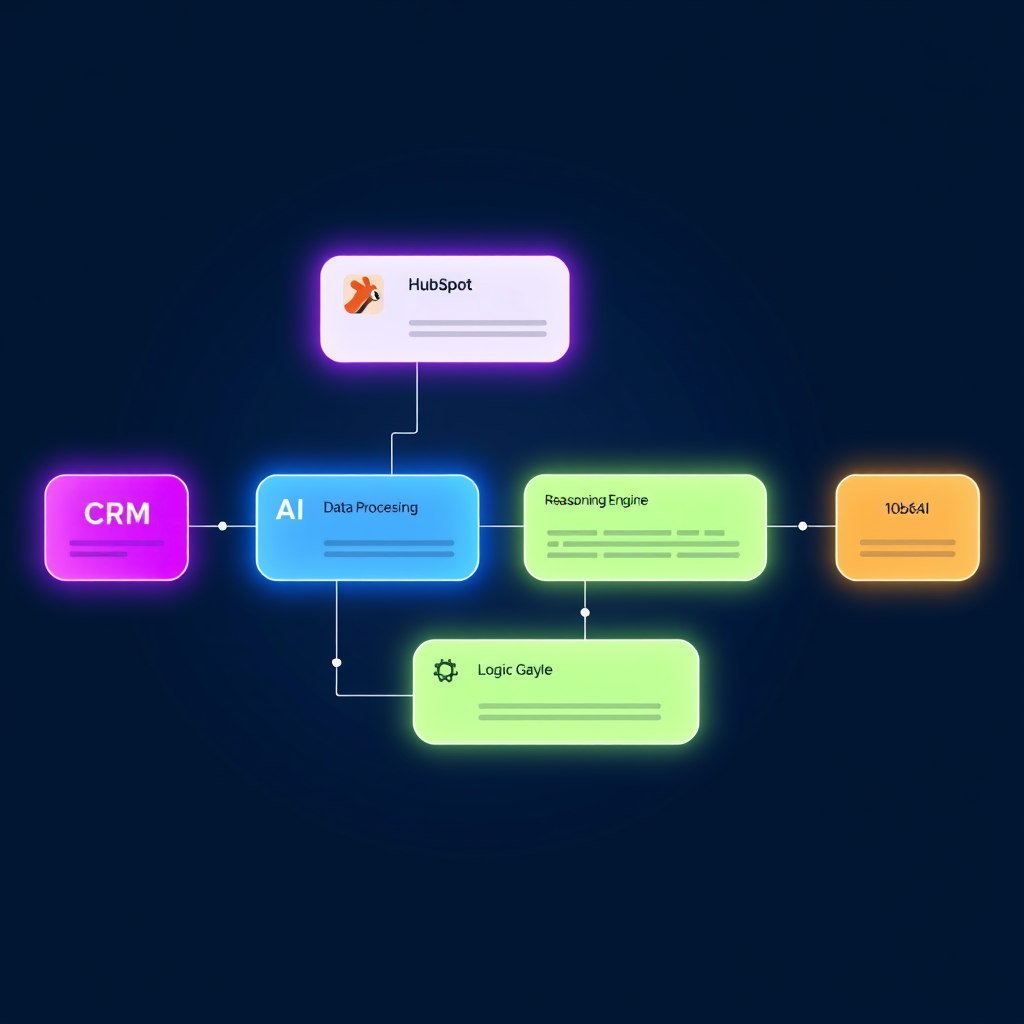
To build a robust predictive system, you need to synthesize data from multiple sources. We typically use the following stack:
- HubSpot: The source of truth for CRM data, deal stages, and contact properties.
- n8n: The orchestration engine that handles the logic, API calls, and data transformation.
- OpenAI (GPT-4o): The reasoning engine that performs sentiment analysis on communication logs.
- Slack: The delivery channel for real-time, actionable alerts.
Step 1: Data Aggregation via REST APIs
The first step in our workflow is pulling the right data. We use n8n to trigger a daily sync from HubSpot. We don't just pull basic contact info; we pull the last 30 days of "Engagement Notes" and "Support Ticket Summaries." If you are struggling to unify your data, check out our Automation Services & Capabilities to see how we handle complex API integrations.
Step 2: Sentiment Analysis with OpenAI
Once the data is in n8n, we pass the raw text to OpenAI. We use a structured prompt to classify the "Churn Risk Score" (1-10) and provide a brief justification.
Example Prompt: "Analyze the following customer support interactions and CRM notes. Identify signs of frustration, feature requests that were ignored, or a decrease in communication frequency. Return a JSON object with a risk score and a summary of why the customer is at risk."
By using LangChain within n8n, we can maintain context across multiple interactions, ensuring the AI understands the trajectory of the relationship, not just the last email.
Real-World Results: A Case Study
We recently implemented this exact system for a B2B fintech client. They were losing 4% of their ARR monthly due to "surprise" churn.
The Implementation:
- We set up an n8n workflow that runs every morning at 8:00 AM.
- The workflow pulls all "Active" accounts from HubSpot.
- OpenAI analyzes the last 10 interactions for each account.
- If the risk score exceeds 7, the workflow triggers a Slack message to the account manager.
The Outcome: Within 90 days, the client reduced churn by 22%. Because the account managers were alerted to specific pain points (e.g., "Customer is frustrated with the API documentation"), they could reach out with a solution before the customer even opened a support ticket. This is the power of predictive customer churn analysis using OpenAI and n8n for B2B.
Why n8n is the Superior Choice for AI Ops
Many teams try to build these systems in Zapier, but they quickly hit limits with data processing and complex logic. n8n allows for self-hosting, which is critical for B2B companies concerned about data privacy. Furthermore, the ability to write custom JavaScript nodes within n8n means we can manipulate complex JSON payloads from OpenAI and HubSpot without friction.
Handling Edge Cases
Automation is only as good as its error handling. In our workflows, we always include:
- Rate Limiting: Ensuring we don't hit OpenAI API limits during high-volume syncs.
- Fallback Logic: If the AI fails to process a note, the system flags it for manual review rather than ignoring it.
- Deduplication: Ensuring we don't spam the Slack channel with the same alert multiple times.
Scaling Your Automation Strategy
Once you have a churn alert system in place, the possibilities for expansion are endless. You can use the same architecture to:
- Automatically trigger "Health Check" emails from HubSpot when a risk score increases.
- Update Airtable dashboards to give leadership a high-level view of account health.
- Trigger automated onboarding sequences if the AI detects a user is struggling with a specific feature.
If you are ready to move beyond manual spreadsheets and start building intelligent, agentic workflows, we are here to help. Our team specializes in turning complex business requirements into reliable, automated systems.
Ready to Build Your Predictive Engine?
Predictive churn analysis is no longer a luxury for enterprise companies with massive data science teams. With the right tools and a clear strategy, any B2B company can implement these systems to protect their revenue and improve customer satisfaction.
Don't let your best customers slip away because of a lack of visibility. Let's look at your current tech stack and identify where automation can provide the highest ROI. Book a Free Automation Audit with our engineering team today, and let's start building your competitive advantage.